

(Written by Mark Bouwman, founder of Brickonomics.net)
If you’ve ever tried to source all the parts for a large MOC, you know the pain. You find the perfect model, you’re excited to start, but first, you need to find a way to source 2,000 parts scattered across dozens of online stores. Each store has different prices, shipping costs, and minimum order requirements. You’re on a tight budget and don’t want to pay more than necessary. How do you figure out the cheapest way to get everything? That was exactly what led me to create Brickonomics.

From PhD Student to LEGO Optimizer
It started in 2022 when I was a computer science PhD student in the Netherlands. I had plenty of knowledge of optimization algorithms, but was short on cash. I wanted to get into MOC building, but when I tried sourcing parts for my first project, I was frustrated by the options available. The existing store selection tools on marketplaces like BrickLink and BrickOwl were helpful but far from optimal. By manually changing the shopping carts, I could get the price down. I thought: if I can do better by hand, then surely, I can come up with an algorithm that does better.
So, I started working on my own algorithm as a hobby project. My early attempts were either way too slow to be of any practical use or still not very optimized. But after about half a year of programming in my spare time, I finally had a working prototype. When I first ran it on a large MOC parts list, I was amazed: the tool saved me over 100 euros compared to what I would have spent using existing tools. That’s when I knew I had to make this available to everyone. In 2023, Brickonomics was born.

Figure 1 – Collection of loose parts.
The Part Buying Assistant: Why Cheap LEGO Is Surprisingly Complex
The first tool on Brickonomics is the Part Buying Assistant. You import a part list from BrickOwl, Rebrickable, or BrickLink, and the algorithm finds the cheapest combination of stores to fulfill your entire order.
That sounds straightforward, but the underlying problem is anything but. Imagine you need 500 different parts. Each part might be available at 200 or more stores, each with a different price. You might think, just pick the cheapest listing for every part. But that ignores shipping. If you buy parts from 50 stores, you’ll pay 50 times the shipping cost. So, you want to consolidate orders. But consolidating means sometimes paying a bit more per part to save on shipping overall. In total, there may be 200500 possible distributions of parts over stores. That is more than the number of atoms in the universe! This is what computer scientists would recognize as a combinatorial optimization problem.
The Brickonomics algorithm explores millions of combinations in the most promising areas of the search space. All the while balancing individual part prices against estimated shipping costs while respecting all the constraints that stores impose. In benchmarks, this approach can save up to 30% compared to the simpler store selection tools offered by other platforms.
The tool has grown steadily since its launch. It’s used hundreds of times every day. Partly directly on the Brickonomics website, and partly through a cooperation with BrickOwl, where the algorithm powers their auto-select feature.
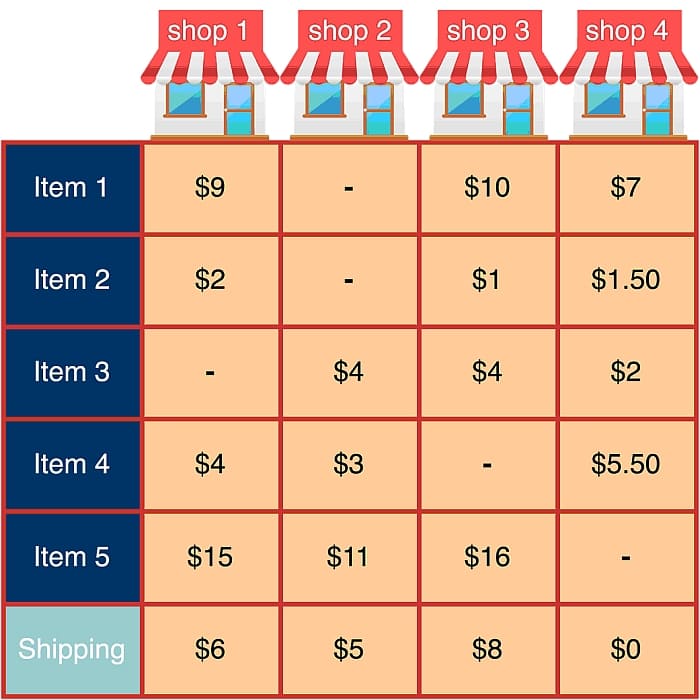
Figure 2 – Example optimization problem. For every part. there are three options. In total, there are 3⁵ = 243 possible ways to make a selection.
The Pricewatch: Finding the Best Deals on LEGO Sets
In 2025, Brickonomics expanded beyond loose parts with the launch of the Pricewatch, a price comparison tool for official LEGO sets. The idea was, again, simple: build a tool to save money and time by automatically finding the best deal.
Brickonomics tracks prices across multiple online retailers and lets you browse, compare, and find the best deals. You can sort sets by current discount to quickly spot the best deals, or browse by theme to see what’s available in your favorite category. But the real value is in the notifications. When you add sets to your personal watchlist, Brickonomics automatically monitors the prices and sends you an alert when something changes. No more manually checking ten different stores every week, you just wait for the email and act when the price is right.
Our biggest retailer coverage is in the US, where we track 21 retailers. In other countries, we support fewer stores (so far!).
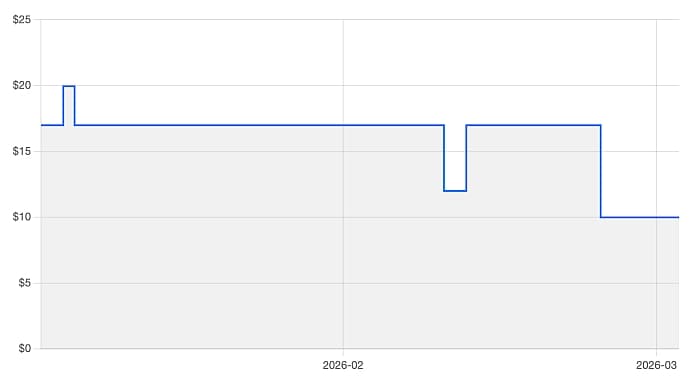
Figure 3 – Price history graph of a LEGO set.
More Tools for the LEGO Community
Beyond the Part Buying Assistant and the Pricewatch, Brickonomics offers a few other handy tools. The Part-Out Ratio calculator helps you find sets where the combined value of the individual parts exceeds the price of the set itself. Ideal for stores that sell loose parts. There’s also a Match Existing Sets tool that takes a parts list and finds official LEGO sets with the most overlap, useful when you want to see if buying a set might be cheaper than ordering parts individually.
What’s Next
Brickonomics is still a one-person operation. But the platform continues to grow, driven largely by feedback from the community. On the roadmap: expanded retailer coverage, minifigure pricing insights, and more analytics and visualization tools.
If you build MOCs, collect sets, or simply love finding a good deal on LEGO, I’d encourage you to give Brickonomics a try at Brickonomics.net. I built it because I wanted these tools to exist for myself, and I’m thrilled that thousands of other LEGO fans now find them useful too. If you have any questions or comments, feel free to share below. Thanks for reading!








Okay, thus is interesting. What stores are you pulling data from?
You can see the list of stores here: https://brickonomics.net/pricewatch/retailers
The content you see depends on your location.
Bricklink has some built in tools to calculate the best combination of stores, but it looks like this tool can pull data across marketplaces. I will check it out as I often work on largish mocs.
Bricklink has their own tool indeed, but their algorithm for calculating the best combination of stores isn’t great. Brickonomics works with Brick Owl and Pick a Brick. For many MOCs Brickonomics is able to find a (much) cheaper solution compared to Bricklink. But this is not a guarantee. Sometimes, especially for rarer parts, it may be that Bricklink just has more/cheaper options. I would say: try it for yourself with a few part lists.
So you’re not pulling data from Bricklink? Only Brickowl and pick a brick? But isn’t Bricklink a much larger marketplace?
Correct. Bricklink is indeed bigger, but Brick Owl still has close to 2000 stores and there are enough good offers to get good prices for MOCs, with the right algorithm. I would love to include Bricklink by the way. It is just that they have not been willing to cooperate so far.
Okay, I will check it out. I’m curious about the results it generates.
Super cool project! I have a background in mathematical optimization (and Lego :-P) so very interested in how you’ve attacked this puzzle. Have you considered modeling the problem mathematically and letting an (open source) solver find the optimal, cheapest solution?
Yes, I have modelled it as a mixed integer linear programming problem and have tried Z3 to solve it, but that did not scale at all. The problem is NP-hard. In the literature this problem has been named the Internet Shopping Optimisation Problem. I ended up using a combination of algorithms with a lot of heuristics to on the one hand explore a wide range of options (avoid local minima) and on the other hand drill down in areas that are promising.
Ah cool. There might be other open source solvers out there that should be able to solve this very efficiently despite this being NP-hard (beating the theory in practice is the whole fun part of using solvers). If you’re curious and can view my address, reach out and happy to discuss!
It would be very interesting to share ideas. I can’t see your address. Can you send me a message via https://brickonomics.net/contact? That way I don’t have to put my email address in a public place where spammers can pick it up.
As someone who spends way too much time juggling BrickLink carts, this sounds intriguing. Saving money and time when sourcing parts is always welcome.
Hmm, mostly I just pick a key part and then I see if the store has enough other useful pieces I can get simultaneously. I have so many bulk and random parts packed down in boxes already.
I guess I actually should do some culling, but it’s hard to figure out which parts that might or might not be useful for my upcoming plans…