

In the past few years investing in LEGO has become a trend and hot topic amongst LEGO fans. Previously people bought LEGO for their children or their own enjoyment, and only considered selling their collection when they wanted to move on from the hobby or had to sell their collection due to financial or other issues. However especially since the use of the Internet it has become quite apparent that LEGO sets, minifigures and parts (especially the discontinued or rare ones) are in fact a hot commodity that can bring significant gains. 🙂

LEGO fans realized that by selling LEGO they no longer want or need they can fund the hobby (LEGO is an expensive toy after all – and more LEGO is always better), or make extra money for other expenses. This trend has progressed so far in fact that there are now those who look at LEGO exclusively (or almost exclusively) as an investment; they buy new LEGO sets in multiples with immediate or future gain in mind, or scout for old LEGO sets they know are still in high demand.
Personally I don’t consider myself a LEGO investor, however I do sell LEGO (especially minifigures) to fund my hobby. In fact I own all my LEGO free and clear just buy investing a little time and effort of doing a few sales a month. Whatever comes in from these sales is what I use to buy new LEGO. I have also talked with some long-time LEGO investors who shared with me that their LEGO investments far outperformed their gains on the stock-market or other, more traditional lines of investment vehicles.

Whether you just want to fund your LEGO obsession, or you are considering LEGO as a serious investment vehicle, one challenge you will run into, and where you spend most of your time at, is price-research. This is the heart-and-soul of investing in LEGO (or in anything else for that matter); you want to buy low and sell high. Today I would like to introduce you to a website that will help you in your price-research and your LEGO portfolio management, so read on! 😉
BrickPicker.com is an online LEGO Price and Investing Guide that was created by two brothers, Jeff and Ed Maciorowski. Jeff is a professional website engineer, while Ed is a professional LEGO fanatic. Together, they realized there was a need for a unique online LEGO destination that would help provide pricing information for LEGO in the secondary markets. Ed grew tired of physically jotting down hundreds of eBay auctions by hand which he used to come up with average LEGO set prices and aid him in finding great deals for his budding LEGO investment hobby. The brothers set out on a quest to provide fair market value of LEGO sets to millions of LEGO fans all over the world. That quest was the creation of BrickPicker.com.
The mission of BrickPicker.com is to educate the LEGO enthusiast, collector and investor of the most up to date and current prices of new and used LEGO sets. Through a partnership with eBay, BrickPicker.com has access to countless current and past auction results from the thousands of various LEGO sets sold on eBay each day. By utilizing this information and putting it into easy to understand charts and graphs, BrickPicker members can make intelligent and cost effective choices when making their next LEGO purchase.
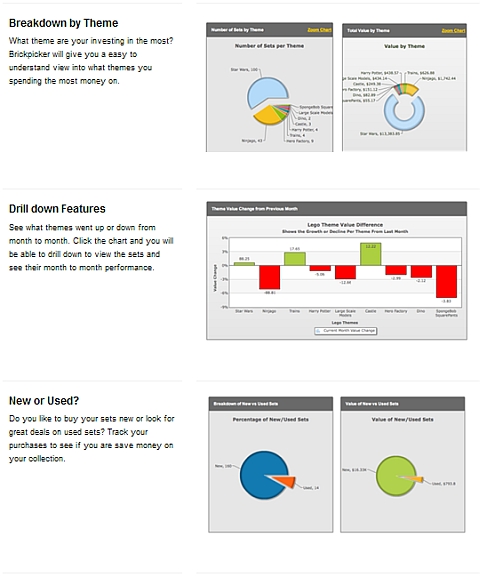
Various tools and data are at the BrickPicker member’s fingertips. Tools such as a LEGO Comparator will allow users to match several LEGO sets next to one another with key information elements such as piece count and pricing trends. This information can help gauge what set may be a better value for their money.
Another tool, the Bulk LEGO Price Guide is available to help answer that question that is seen so very often on forums, “How much is 100 pounds of LEGO worth?” Just move the weight slider to your desired setting, select filters such as theme or specific colors of pieces and find out what past eBay listings sold for.
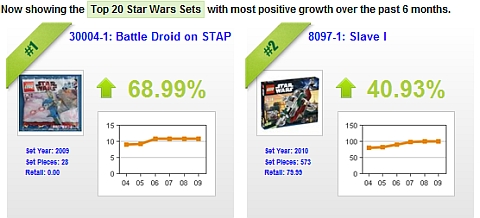
The core tool for BrickPicker.com is its BrickFolio. This is an investment tool, much like you would see on any financial website that will allow collectors input or import their entire collection of LEGO sets from other sites and get up to date values while giving some key insight into their collection.
A few remaining and notable features for the site are it’s Blog & News Aggregator that constantly grabs the latest news (including our news here at TBB) from all your favorite LEGO sites and display them in a fun and easy to read way, reports about Top Selling LEGO Sets, links to find the best prices on LEGO and a very active Forum with members that talk about the great deals they found.
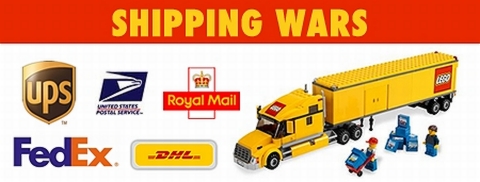
Another thing that is quite unique about BrickPicker is its content. Their blog, known as the BrickVesting Blog covers areas of content that discuss topics tailored to the collecting and investing of LEGO. Article topics such as “Shipping Wars” talk about issues of trying to get that pristine LEGO box for better resale value in the future. One of the most read blog articles is “LEGO Investment Bubble: Fact or Fiction?” looks at some data and other collectable markets to forecast whether an investing bubble does exist.
While the BrickPicker has key information about the multitude of LEGO sets in existence, their focus is about the value of these sets and their place in the LEGO investment world. So take some time, visit BrickPicker.com and use it to make intelligent and cost effective LEGO purchases in the future. I’m also adding a direct link to BrickPicker in the left-hand side-bar so you can quickly get to the site when you need it.

If you have any questions or comments about BrickPicker’s features, feel free to share them below. You might also want to check out the LEGO Shopping Tips section for related articles, or choose from the posts below:







Like you, I do not consider myself a LEGO investor, but I do buy a lot of LEGO to resell. It simply pays for my hobby, and is self sustaining.
Hi I have lego from 1992 sets and instrutions.am looking for a buyer
What sets r they is it lego technic sets which I have 3 big sets 4100 pics bucketwheel excavator 2400 pca Mach truck 1200 pics 24 hr green & white Lemans car.
I don’t plan on selling my LEGO sets. I just learned how store my sets and also become selective on what sets I buy. When I get old and the LEGO sets have lost there magic with me . I plan on giving my LEGO sets to children that never had a chance to experienced the magic of LEGO. Like I’m having now.
The point is that you don’t sell the ones you have, you just buy more specifically to sell. I would’nt sell my LEGOS, but I would certainly buy LEGOS just to turn around and sell them for double.
Garmadon, yes, some people keep all their LEGO sets, and some buy to sell, but there is also the in-between strategy of buying sets for yourself and selling some of the parts or minifigs from it. This is a great way to fund the hobby without risking of buying extra sets or sets you don’t really want for yourself. You are not going to get rich this way, it is not for running a business, but it definitely bring in enough to have regular spending money for LEGO. 😉
Yes, that is a joyful and noble way of exiting the hobby. If you would like to share how you are storing your sets let me know. That is always a big dilemma and a big topic! 😀
I don’t have trouble storing my sets. . . I divide them up and sort the pieces in peanut butter jars! 😆 😉
LOL! That’s actually a great system! Also quite portable! 😀
And the best thing is I don’t have to pay for them. . . 😀
My name is from the store I had on bricklink(dot)net. I bought and sold individual pieces all over the world. I didn’t make a big profit when I liquidated after son moved on. When I first started sell off I had no idea and sold my mini figs by the pound ! The catalog on that site is fantastic for pricing LEGO™.
Oh, minifigs by the pound! I would have loved to buy those! 🙄
I have a lot of those minifigs
Yeah. BrickPicker is a cool site (I did an article for their BrickVesting blog). It is a great idea, really. I don’t know why other people didn’t think of making something like BrickPicker. Ed and Jeff are nice and cool as well, plus they participate in their website (commenting and going in the forums) -which makes it even better! 🙂
Yes, it is a brilliant and very helpful. Perhaps the reason others have not done it is because it is not an easy process. As far as I know the brothers are paying for the data used, and it also requires programming skills to pull something like this together. I know I couldn’t have done it. 🙄
Anna, you are KILLING it with the latest articles!!! AWESOME JOB!!! This is very useful information, I hope we sell well during this 4th quarter.
LOL! Thanks, Micho! I can yack on about LEGO all day. Might as well write it down instead of driving my family and friends nuts. 😉
I’ve sold extra min-figs. I’ve thought about picking up extra sets on sell and sell later. I’ve just not had the extra cash when I found a really good deal. You really need to know retail prices to know what a good deal is.
That price guide is real informative.
Chris, yeah it is curcial to know your prices. One way to achieve that is to focus only on one theme. It may sound limiting, but the point is that you can jump on a deal right away because you know prices in that theme in and out. Some people also keep a log of retail prices as well as BrickLink/eBay prices in an easily accessible folder they can reference as they browse stores, garage-sales, or online. It takes some work, but it is doable. 😉
For a lot of sets though, you can guess the price pretty accuratly just by the box size, at least if you’re used to it. 😉
Yes, and also by the piece count. 😉
When I shop for LEGO, I use employ a few simple rules. If the set is less than $.10/piece, it’s a decent value to me for purchase. If the set is selling for around $.05/piece, it’s a good “investment” for future reselling. If you find LEGO for less than $.05/piece, it’s a no-brainer to buy it. You will (almost) always make money.
These price points can be adjusted up slightly for popular licensed themes like Star Wars, Avengers, and Lord of the Rings.
Eric, yep, that works very well. Pretty much any LEGO sets you buy for retail price or better will sell for a profit either as a full set or parted out. 😉
I actually figured that just by buying a few ninjago sets and then splitting them up, you could get 150% of your money back again – the Ultra Sonic Raider, for example, you can sell Pythor for $40, the four ninjas for $40 or so, and the Raider w/o minifigs for another $40 (or even 50 – 60). Unfortunatly, I’m not in the US. . . otherwise I would have done that! (But next year. . .)
Yep! That’s the idea! 😀
Some comments about a possible speculation bubble. I think most collector’s items become items precisely because they were considered worthless in the first place, and when the nostalgia demand hits decades later, the supply is limited because most of it has been thrown away or deteroriated in funky garages.
When something is marketed as a collectable instantly, the supply remain higher than the demand, and what happens it’s exactly the opposite, bubbles burst and what was so expensive when it was basically new and fresh has to be thrown away for pennies.
I guess Lego will never be worthless, since at least in itself it functions as a constructive toy, whatever happens, but it’s worth bearing in mind if you count on making a buck later in life.
Hakan, yes, those are very good points. However there are some things that makes LEGO a pretty safe investment. Some you already mentioned, like the fact that you can always part out the set and sell the parts. Just by doing this you can double your money, although it can take some time to sell all of it.
For investment, I would ALWAYS look for sets that are not just potentially hot now or in the future, but also comes with tons of useful parts. For example all the Modular Houses and other large adult-oriented sets are excellent for this purpose. Even if selling the set as a whole would not bring in the profit you want, you can part it out with selling all or most of the parts quickly.
LEGO is an excellent investment also because the availability of sets is limited to a few years only. Once the sets are gone, they are gone, and only available in the secondary market. And there will always be people who want them and who are willing to pay the price. I would say as long as long as the Internet, shipping services, and in general the world as we know is around, LEGO is going to continue to be a great investment. Of course if the world ends this December… well, and least we die with our toys. 🙄
I wouldn’t buy sets on the already inflated secondary market and try to sell that in the future (the notion of buying high and trying to sell even higher – which is a no-no in any investment field), but as long as you are buying retail or better, you will make money. It is pretty much garanteed. 😉
I’m actually startled that culling out parts works that well.
This is the heart-and-soul of investing in LEGO (or in anything else for that matter); you want to buy low and sell high.
I have lego sets and instrutions back from 1992.i have a chest full and wanting to sell the lot.my number is 07577840720
Jonathan, I would suggest that you take good pictures and list your lot on eBay. That would be your fastest option. You can also reconstruct the sets and sell them on BrickLink by set. This takes more work, but you would also get more money for them.
I would like to re build but haven’t got the time.i also have the mini figs.just looking foe a buyer to take all.
Jonathan, you might consider mentioning your intentions at the BrickLink forum. Please note that no buyer is going to bite unless you have at least some pictures. You might also consider advertising locally for a quick sale. The UK also has graigslist, right? I’m in the USA, so I can’t help out, but if you have any other questions just let me know.
Hi
I have an official ex display model of Lego disney pixar models and wondered if anyone would be likely to buy it and how much it might be worth or how much I should ask for it.
There are about eight different cars in a plastic do me case.
Thanks
.
Thanks Ann
Ann, is this what you have? http://www.bricklink.com/catalogItem.asp?G=4646117. There is no price-guide info for it on BrickLink from the past six months, however similar displays sell for about $100. You can try selling it either on eBay or BrickLink. You will find a buyer as some people collect these. 🙂
Thank you for your quick reply. Yes it is like the link you sent but I think some cars might be different.
I think I’ll try Bricklink first and see how it goes.
Which part do I advertise it on?
You can tell I’ve not done this before!!
Ann.
Ann, yes, I would also recommend BL first. I think if yours is close enough, you could advertise it under the same one I linked to before and just add your own picture in the description. Or you could also check out this other one: http://www.bricklink.com/catalogList.asp?catType=G&catString=539.748 and se if that matches better.
If it is totally different you can also sell it as a custom item, that way you don’t have to worry about adding it to the main catalog. Whichever way you do it, make sure you announce it at the BL forum. Unique items like this usually get more interest if people on the Forum know about it.
Depending on the condition, I might start with a price of $120 and see how that goes. If it doesn’t sell you can always go lower. If it doesn’t sell within a month, I would go the eBay route. Also, I would suggest to only allow buyers from your own country, or surrounding areas. I would not risk selling this international.
Thank you for your information it was really helpful.
I will definitely do what you suggest and hopefully it will sell.
I may look out for some more if these it would definitely be worth iit.!!
Ann.
Yes, there is definitely a demand for these. Not overwhelming demand, but enough to sell them. One issue with these displays is that the LEGO sets inside of it are glued, so some people don’t like them, but they also make nice displays. If you can find some of the popular themes like Star Wars, Ninjago, Legends of Chima, you should be able to sell them for more. 😉
Selling Batman lego!
hi,
i have lego agents 8635 used but all there , with box and instructions built once not played with.
Lego city 7744 as above
lego greengrocer 10185 as above
lego firestation 10197 as above
lego grand emporium 10211 as above
just wondering how much they are worth ready to sell
many thanks
Debbie
i have special edition lego billund airport produkt 4000016 can nok buy in shops i will sell it for 500 usd if interested send email
Great part, always love reading about LEGO and money 🙂
As with all investments, only invest with money you can loose.
Don’t jump in late and buy as low as possible.
The 10 cents a part rule is a good rule to live by, anything under is better than anything above it, the lower the better.
The bubble will burst for those that bought to late of sets that all others bought too.
Sets will only appreciate in price if there are to little for demand to keep up.
I also do not resell for profit, but to keep up my LEGO habit, I call it funny-money.
It is used to buy other LEGO to resell and/or for my own collection.
To make money (in any system) you need to do a lot of homework and buy and sell on time.
A set that is right now worth twice it’s shop price can drop fast if more turn up or if LEGO re-releases it or simply makes to many of said set.
Remember, it is a toy, so enjoy (selling).
Now, I need to start selling again soon, to buy more 2×4 🙂
I have at least 50 Lego boxes of all sizes (without the Legos). Where do I find buyers for the boxes? What sites or groups are best?
MD, you can sell your boxes on BrickLink.com. Boxes for rare and expensive sets should probably sell. Boxes for cheaper, common sets are probably not worth keeping. You can check the price and sale history of each box you have, and that should give you a very clear idea if it is worth listing them. 🙂
Thanks!!
I just found about a dozen red, white, blue huge extra large Legos—like 2 inches by 4 inches with vintage lego letters. I can’t find any info on these. Is there a place anyone can help? Many thanks!
Dawn, my guess is what you got is Quatro bricks: http://www.bricklink.com/catalogItem.asp?P=48201. Here is some info from Wikipedia: “Quatro was a product range of the Lego construction toy, designed for children aged 1 to 3 years old. Quatro bricks are twice the length, height and width of Lego Duplo bricks (eight times the size in volume) and four times the length, height and width of traditional Lego bricks. Initially launched in 2004, they are designed to be easier for younger children to handle. Despite their size, they are compatible with Duplo bricks which are in turn compatible with traditional Lego bricks. The Quatro product line was discontinued in 2006.”
I bought my grandson a Lego Agents 2.0 #8969 Wheeling Pursuit which he never played with. The set is sealed in the box, unopened.
It looks like it is rare and worth about $120.
Would someone want it and give me a good price for it, so I can use the money to help him with his education?
Jean, that set is not worth more than $50 in new and excellent condition. It goes for even less both on eBay and BrickLink. So it’s unlikely you will get anywhere near the price you want for it. You can always put it up on eBay as an auction and see where it goes, but I just checked and $50 is the current going price (or $60 with free shipping).
Hey, I have a mint condition Lego Quasar Watch System, still with its original outer packaging, and I can’t seem to be able to find it online !
Can you tell me what it might be worth or where I could find out ?
The barcode isn’t recognised anywhere.
I was told that it was a Japanese Import, but I am dubious, it has its instructions and warrentee and guarantee cards intact to !
Any info would be helpful !!
Danny, any pictures?
Woah, found this article from 2012! Hello, anyone still alive on this article?
Of course! We are still here. 😉
we are hoping to sell our collection, over 500 pieces
No room to store and figure they will bring enjoyment to others…
Anyone interested? We are in Canada but will also ship to USA
Jacqueline, the best way to sell a collection like that would be at a local marketplace like Craigslist. You can also consider eBay, but it is more of a hassle.
I am looking for the Lego Aviator Lunch bag! Any ideas? Or anyone know someone who is selling one??
Missy, as far as I know that is a discontinued item. You may find it on eBay, but other than that I can’t think of another resource.
I have a store display and wondered what are the selling prices of them? I’ve researched but really couldn’t find anything but a few on eBay. It is a Duplo/Junior/City display.
I have a Lego store display and wondered what are they worth on the Lego market. It’s a 3 in one display: Duplo, Junior, and City. I’ve looked on eBay and saw a few. I’ve researched but can’t really find anything. Do people collect those?
Yes, people do collect those. We talked about them here: http://thebrickblogger.com/2013/09/lego-display-banners/. If it is a cloth banner, those are especially desirable, but large poster banners sell well too. 🙂
Thank you but it isn’t a banner. It is actually a 3 in one store display model from a floor set that was being tossed out. The theme is cops so each shows a Lego scene where cops are arresting criminals. It is about 3-4 feet long and has working lights. The Lego figures and buildings are glued however. Didn’t know if there was a market for those? Like I said before I really couldn’t find much about them
Do you have any pictures? I think I know what your might look like, but I’m not 100% sure. There is definitely interest in store displays, and although they are quite unique, usually they do sell. 🙂
Oh cool! I do have a picture. Where can I send it? I don’t see an option for it on here.
I was wanting to know if the value of the minifigures that come as a series is affected if they are left unopened? Is the answer affected by time?
In my experience not so much. People who want exact minifigures don’t mind if the package is already opened, as long as the content is all there and accurate. I have seen sellers not opening the package at all, cutting open just one corner to verify the content, fully open the package, but still include everything (including the package and the leaflet), and only include the content of the package transferred to a ziplock baggie – the prices are the same.
As far as the effect of time, waiting for a few months to a year can definitely increase value, however if you wait longer you run the risk of LEGO releasing a similar minifigure and the original loosing value. For example one of the most popular and expensive minifigs have been the zombie from Series 1. However now that this whole series of zombies have been released I’m pretty sure that the value of the original one will drop – simply because people have a fresher, cheaper alternative.
I picked up a Ferrari FXX 8156 Lego set second hand. My kids assembled it and then I looked it up online and it looks to be pretty valuable. Did it loose it’s value because we opened it and assembled it or is there still a market for selling it?
Autumn, yes, there can be a significant difference between an opened and unopened set. In the case of the #8156 Ferrari FXX, unopened sets go for between $200-$250, and opened set for around $100.
I have a few Legos some built some not built which I want to sell. Any help on where I can sell it?
Camila, you can sell them on eBay or BrickLink, or if you don’t want to bother with shipping, you can also sell on Craigslist locally. 🙂
i wood ilke to sell my lego
Mark, you can contact the site directly to sell your collection. Or you can also sell at other venues.
I have a bunch that my son wants to sell but I have no idea how much to charge..
I have marvel, ninjas, pirates of Caribbean, Star Wars ,DC, and a bunch of the series
Misty, you can research going prices both on eBay and on BrickLink. BrickLink in particular has a six months price-guide that will show you exactly how many people bought the particular set and for how much. It also shows you how much new and used condition sets are going for. Give it a try. 🙂
like to know more for my huge and fabulous collection; please contact.
If you are into lego investing, take also a look at http://www.losapos.com. They ship and store your lego investments for free.
Oh, dear. This sounds like those gold vaults! If I wasn’t convinced that LEGO is in a bubble, now I am! 🙄
Hi
I am wondering which is more valuable to sell: Lego sets that are already completed, or a tub full of Lego not completed (with instruction books). TIA.
Cath, interesting question. One of the most important part of the LEGO hobby is the enjoyment of putting the set together. I have never-ever seen someone pay more money for a set that has been already assembled. In fact, it will almost always go for less, as people would have to take apart the set so they can build it themselves. Also shipping completed sets would be a nightmare as completed LEGO sets don’t travel well. So yeah, definitely loose pieces with instructions instead of completed models.
Can anyone tell me about LEGO Camera Spybotics i bought one in box wrapped but can find anything on this
Eddie, they are interesting robotics sets from 2002. They are listed in the BrickLink Catalog here: http://www.bricklink.com/catalogList.asp?catType=S&catString=436 and also on Brickset: http://brickset.com/sets/theme-Spybotics. You can also read about them on Wikipedia here: https://en.wikipedia.org/wiki/Lego_Spybotics. If you have questions feel free to ask. 🙂
My husband has been collecting Legos for years, specifically Star Wats sets. I’m wondering if someone may have an idea where to go to sell them?
Shelly, the best place to sell LEGO is on eBay or BrickLink (it’s like eBay but only for LEGO). Or, if you want to sell it locally, you can also go the Craigslist route.
I also have collected LEGO sets for many years but there are many sets that LEGO didn’t produce anymore :(((. I tend to buy these retired sets on lepinworld. but is the quality of the products good? Or anyone have retired sets can sell them for me? Thanks
Please note that Lepin is a rogue company from China that blatantly steals designs from LEGO and LEGO fans. Please do not support these thieves. LEGO is in a legal battle with them, but since China doesn’t support IP rights, it is a drawn out process. If you would like to purchase retired LEGO sets, you can find them at BrickLink, eBay, craigslist, garage sales, second-hand stores, etc.
I bought some clone sets in Aliexpress or to use their minifigures but it seems quality of the knock off sets is not good :((
it’s very bad and i’ll never comeback there
Last week was my brother’s birthday, I bought him Star Wars at Lepin. And unfortunately it is a fake, poor quality and lack of pieces. Hope you do not encounter such a case as me.
It’s so sad to read about people buying fake Lego sets from Aliexpress or Lepin. Please be careful.
I have been investing in Lego sets. I try to buy low and sell higher than the purchase price. I try to focus on sets that are about to retire and buy the ones that go on sale on Amazon, Target, Walmart. It’s fun and exciting and most of all, I make extra spending money… I get great satisfaction from helping others so let me know if you have any questions regarding investing in Lego sets.
I have a large tote full of legos I have had for over 18 years. Want to sell them to someone who will appreciate them. Does anyone have any suggestions.
Dottie, you might consider your local Facebook or Craigslist marketplace. That’s usually the easiest way to sell quickly. You can go through the online selling route as well, but it takes much more work.