
(Written by William)
In this Brick Breakdown series I review official LEGO sets, from the perspective of looking at interesting building techniques we can all learn from. Today we will be looking at one of the LEGO Lone Ranger sets, the #79107 LEGO Lone Ranger Comanche Camp. You can also check out the previously discussed LEGO building techniques found in official LEGO sets (including other LEGO Lone Ranger sets) at the end of this article.
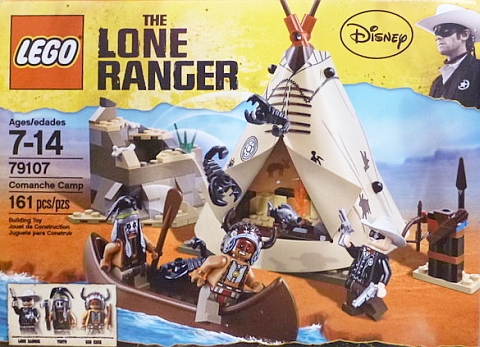
With the LEGO Lone Ranger Comanche Camp the teepee is back, and so is the LEGO canoe! I missed the LEGO Western series that came out in the 1990’s, so I was especially excited about the LEGO Lone Ranger sets. Now fans like me got a second chance to experience the very unique style of native American LEGO sets and designs.

Most LEGO sets have a strong focus on things built by modern man (or built by modern minifigs, if you will). There are some exceptions to this of course – like the LEGO Lord of the Rings and LEGO The Hobbit sets – but the point is that they are more the exception then the rule. So it was exciting to see another theme where to main characters are people who are so attuned with nature. How will LEGO portray them? I couldn’t wait to see what was in store in the LEGO Lone Ranger Comanche Camp!
➡ FRAMING FLEXIBLE LEGO MATERIAL
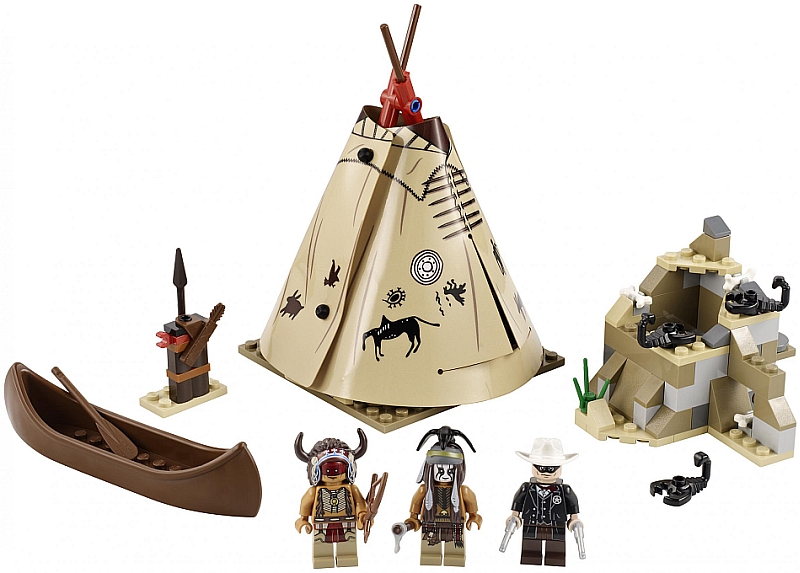
The first thing anyone will notice in the LEGO Lone Ranger Comanche Camp is the teepee. It stands majestically apart from the rest of the set thanks to its size, shape, and decorative appeal. All this is possible due to the glossy paper-like material that makes the outer-shell of the dwelling.
If you ever had a chance to work with flexible LEGO elements, you know the process can be a bit tricky; nets, sails, cloth-capes, strings, and pretty much anything that is not made of hard plastic, seems to have a mind of its own. For example in the past LEGO pirate ships relied on the use of strings to hold the cloth-sails. They were quite irritating to deal with and created an unstable model that didn’t hold up well to play. Since then LEGO has improved most of these non-standard elements and they are easier to work with. Still, you need to follow some basic principles to make them look right.
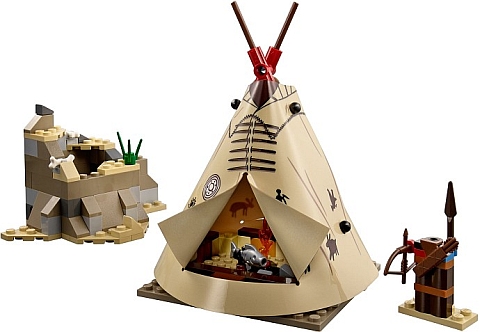
The first step in dealing with these non-standard LEGO elements is to start by controlling the corner/ends of the flexible material. This will be important when attempting to shape it to form seamless structures. Many times you would want the material to blend them together with other LEGO pieces. If you don’t have a firm grasp of the corners/ends, this may result in some unsightly bulges. In order to have this control, you must keep the material precisely taut. Make sure each corner or end is firmly anchored in place. Thankfully, this set uses this principle very well as the ball-joints fully stretch the material out. However the teepee in the LEGO Comanche Camp set goes one step further. It creates a non-attached framework at the base of the teepee. This consists of a rounded circular shape that forces the flexible material to bend evenly around the model.
Although as LEGO builders we are not used using soft materials like the teepee-shell in our creations, they do have great benefits; they are flexible and makes wonderfully curved shapes, so why not take advantage of their unique attributes? Something to note is that creating additional supports for rounded shapes is fairly easy, but it can get over done. You will want to approach this issue by using as little as possible. After all, the advantage of flexible materials is their light weight. The LEGO Comanche Camp set accomplishes this by placing the additional framing below the teepee flaps. This gives needed support but does not get in the way of the design, while letting the teepee material show off its full beauty and unique shape.
➡ CREATING NATURE WITH LEGO
The other exciting section in the LEGO Lone Range Comanche Camp is the scorpion nest. It definitely has a natural flair, something that can be hard for new LEGO builders to create. The truth is that it only looks tough to master, but is actually quite simple. The key is creating asymmetry. As humans we tend to gravitate towards making our models symmetrical and balanced. This is the uniqueness of man-made structures like cars and buildings, but it is not what you would find in nature. Take a look outside. There are no straight lines or complete symmetry anywhere.
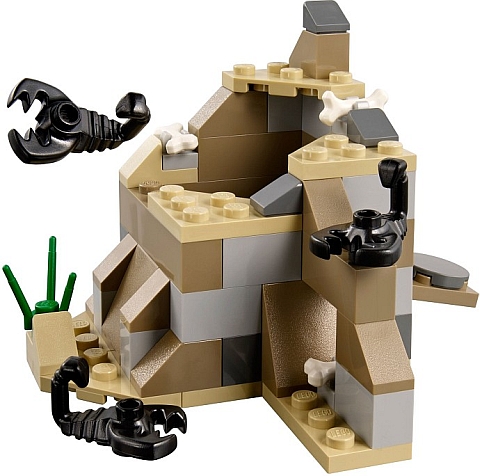
However when we look at our LEGO elements that are all identical and symmetrical, we have trouble seeing how to create asymmetry with them to imitate what we see in nature. You will notice that LEGO designers tend to utilize slopes when making settings that supposed to look natural. Slopes can help you to break up the symmetry of LEGO bricks and thereby create a more natural, broken up surface.
To achieve this effect start by putting a regular LEGO brick on one side and then a slope that fulfills the same purpose on the other. Now no matter how hard you try to make both sides the same, one will be just a little different. The technique can be further enhanced with different sized and angled slopes as well as differently sized bricks. The end result is something that should approximate a surface found in nature. This is one of the few times where imperfections make a perfect design.
You can also use colors to make the surface you are creating more natural. This can be achieved by mixing like colors. Tan and dark-tan, gray and dark-gray, brown and dark-brown, and not to speak of all the greens will give you that natural look or mottled surface. A good rule of thumb for mixing colors is to pick out two main colors first. Then find a third color that compliment the other two. For example reddish-brown and dark-brown are nice choices for an old tree. You can add in some dark-green as a deep mossy growth spread out sparingly, and you have a fantastic color pallet for a natural look and feel of your LEGO model.
➡ APPLYING WHAT YOU LEARN
Using flexible LEGO materials is fairly rare in a typical LEGO creation. However, when it arises it presents some very interesting possibilities. The challenge that was not addressed in the LEGO Lone Range Comanche Camp set is instances where you need a flexible LEGO element to sag in a certain way. If it is possible, try weighting the material to help shape it. The weight doesn’t have to stay in place all the time, just long enough for the flexible material to “learn” what you want it to do.
As fun as flexible LEGO materials are, it often comes down to measurements. Sometimes no matter how you maneuver the element, it is just not the right shape. For this reason advanced LEGO builders will often find themselves making their own pieces. String and no-tear paper are fairly simple materials to cut and shape on your own. Craft-stores then become an ideal place for discovering customization options. Plus, it can be argued that it is often easier to experiment with non-LEGO materials since you have no fear of breaking or tearing them.
As for nature building, it all comes down to texturing. You can texture both dimensionally and with color. If you still find you have trouble creating natural surfaces, try placing a few small random LEGO bricks in colors you dislike on your model. Then force yourself to build around these obstacles and cover those colors up. This is a great way to augment the overall shape of a design. The most difficult thing to overcome is preventing yourself from creating solid smooth walls – that won’t look natural. For this reason I suggest the use of LEGO slopes. Slopes give you the distinct advantage of eliminating stud options directly above their sloped surfaces. This ultimately generates some interesting angles – provided you don’t copy them on the opposite side of your model. Given enough obstacles for yourself, you’ll eventually learn how to make your LEGO design look unique, spontaneous, and most of all natural. 🙂
So what do you think? How do you like the LEGO building techniques discussed here? Have you tried using flexible LEGO elements like cloth-pieces, soft plastic parts and sails? And how about creating natural scenes from LEGO, like rocks and trees? Did you find the process easy or challenging? Feel free to share your own tips or ask questions in the comment section below! 😉
And you might also like to check out the other reviews in this series:
- Brick Breakdown: LEGO Lone Ranger Stagecoach
- Brick Breakdown: LEGO Star Wars AT-RT
- Brick Breakdown: LEGO Arkham Asylum Part 1
- Brick Breakdown: LEGO Arkham Asylum Part 2
- Brick Breakdown: Legends of Chima Polybags
- Brick Breakdown: LEGO Ninjago Samurai Mech
- Brick Breakdown: LEGO City Alarm
- Brick Breakdown: LEGO Battle of Helm’s Deep