

(Written by William)
I’ve always been a big fan of the Super Hero sets, especially when it comes to Marvel. However, in recent years, I’ve gotten a bit burned out on the sets due to repeated set designs. However, the Fantastic Four haven’t really fallen into this category. And the #76316 LEGO Fantastic Four vs. Galactus set was also an easy way to get the full line-up of the group, plus get one of their most iconic foes, Galactus. Still, I wavered; nearly all the films I tried to watch of the iconic team have not really excited me for the franchise.

What finally turned the tables was the MCU’s version of the Fantastic Four: First Steps movie. This was the first time a studio leaned into the retro futurism that the Fantastic Four thrive in and made them what they are. They also didn’t shy away from making Galactus a large man instead of some nebulous concept. This gives him a clear and highly recognizable art direction. So, with this renewed interest, I asked LEGO for a review copy of the set to see if it is worth the $59.99 MSRP.
CHARACTERS WITH POWERS
As mentioned before, this is an easy way to get the four characters of the Fantastic Four. It was a little sad not to get Sue and Reed’s baby, but that doesn’t take away too much from this set. The nice thing is that each figure is given just enough accessories to showcase its powers.

Mr. Fantastic comes with extensions for his legs. This makes him look like he’s on stilts, but thanks to the coloring, it does an adequate job of making him look like he is stretched out. This was just enough to get the point across, without having a mess of parts to make his minifigure unstable.
Next up is the Invisible Woman. As much as having a clear minifigure would have been amazing, it would ignore a lot of the character’s design. So, instead, LEGO designers leaned on the other side of Sue’s powers. This is her ability to generate invisible force fields. Representing this with hand-held dish designs is an elegant way to do this.
After Sue comes the Thing. Ben is the largest of the team with his rocky façade. However, unlike most versions of the Thing, the one that came out of this movie just made him a larger-than-average person. This means he would not be proportionally correct if he were made into a maxi figure. As much as I wanted that, it is truer to the film by just giving him the large hand attachments and a rocky scalp piece.
Finally, we have the Human Torch. I was surprised he didn’t get his full flame-on appearance, but just like Sue, that would have eliminated most of his character’s design. So, he is left with his normal form and got flame shots for his hands and flames coming out from the bottoms of his feet.
All in all, this is not a bad compromise for the minifigures. It allows you to see the actors that play these characters, while not ignoring the characters’ fantastic powers. It also leaves room for more versions of these minifigures in the future, perhaps when they cross over to other films.
GALACTUS THE PLAYSET
The rest of the set is entirely devoted to building Galactus. I appreciate that LEGO designers didn’t try to put in something silly like a weapons rack or partially broken building. All parts are Galactus-focused. And even though, for true scale, he could be bigger, they did an excellent job with his range of motion and posing ability. For the more exposed joints like his shoulders, hip sockets, and knees, they created hinged covers or flaps that make up his clothing to hide these connection points. What you end up with is a construction figure that presents a rather pleasing aesthetic, more than a mech or most other constructible action figures.
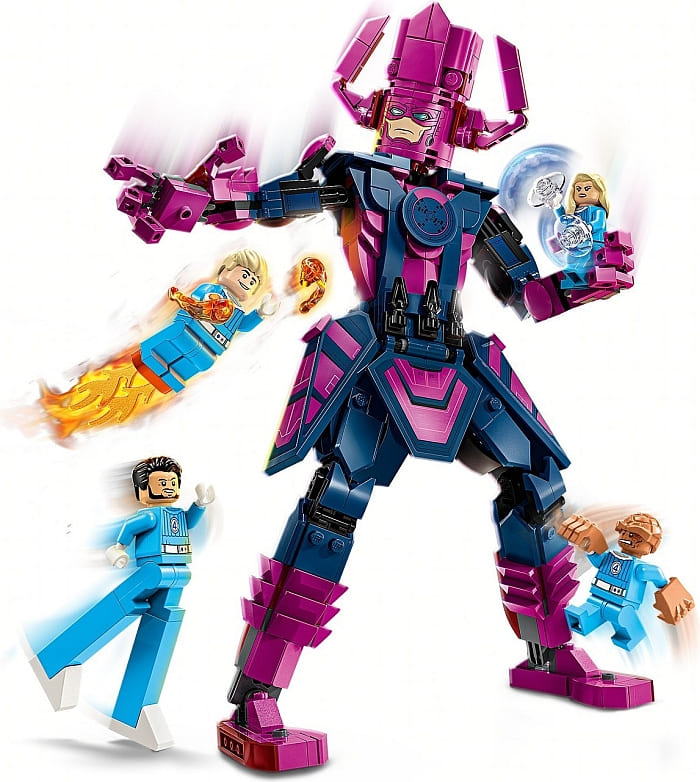
Since you have to play and position this figure to play, let us discuss its joints. His head sits on a large ball-joint, giving him the perfect amount of motion to turn and look in every direction. Moving to his shoulders, they are also on large ball-joint to give each arm a wide range of motion. It is worth noting that when it comes to Galactus’s limbs, LEGO designers kept them slim. This gives Galactus the ability to better hold weight, like a minifigure, in each hand.
Continuing on the arms, the elbows consist of two hinge-plates. There is a wedge-plate that keeps these hinges from opening fully and maintains a slightly bent posture when fully opened. Moving down to the wrist, they are on small ball-joint connections to allow maximum expression with the hands. The hands have four fingers, one of which is a thumb that moves perpendicular to the other three fingers.
Moving back to Galactus’ torso, there is a large ball joint hidden inside his waist. This connection is built up to prevent tilting, but it does allow him to twist his torso. Moving further down to the hip joints, these are locking joints with clicks to maintain different positions. There are two points of movement here. The first allows you to move the legs forward and back. The second allows you to move the legs closer or apart from one another allowing for a more stable stance.
Finally, we have two more joints on each leg. They are both large ball-joints. One is in the ankle while the other is in the knee. Most of the time, constructions similar to this will have fixed-angle knees. However, Galactus is a light build when it comes to limbs, so it does not need the added structural support. Additionally, this does allow fans to build their own Galactus throne, which he will be able to sit on, thanks to this joint configuration.
So, that covers his joints, but what makes him a playset? Well, LEGO designers snuck in several studs to allow fans to mount minifigures onto Galactus. I’m not counting the flying mount that the Human Torch uses to fly over Galactus’s shoulder. Rather, I’m referring to studs left on his palms and feet for minifigures to attach to. There are also studs on his upper arms and thighs for even more climbing potential.
What you end up with is a highly flexible character that can act like a jungle gym for any standard minifigure. They do all of this without sacrificing how Galactus looks. In other words, he doesn’t appear to be a robotic version of his character. Having built my own large-scale characters before, this is an extremely impressive feat.
FINAL THOUGHTS
So, is this set worth the price tag? That is a tough one. It does seem a little light on parts for the price. However, the number of characters you get does help justify the added cost. The main question is what type of fan are you?
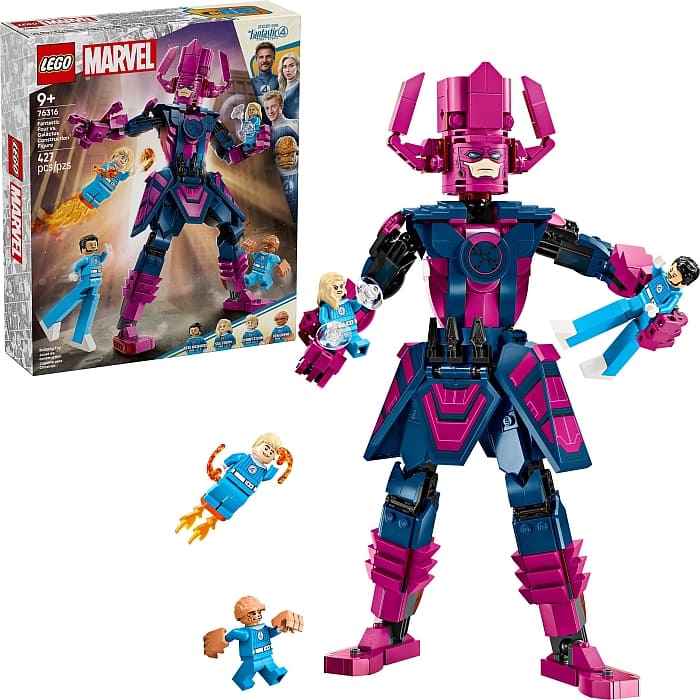
There are some compromises made in this set. For example, I was surprised not to see the Silver Surfer. Considering the MCU did a gender swap on the surfer, they might have felt that comic purists who wanted a male surfer would have been upset. So, this does seem to straddle the line between the movie and comic books. Overall, the Fantastic Four have struggled to gain traction with modern audiences, so broadening the appeal to as many people as possible is a wise decision.
As for who this is set for? You kind of need to be a fan of the Fantastic Four. There is not enough of a building experience that a LEGO fan needs to go out of their way for to build. So, my recommendation is to check out the Fantastic Four First Steps film first. If you come away liking that movie, then you might want this set. If you don’t care for the film or are on the fence about the Fantastic Four, this set won’t change your mind. But for the big comic fans out there, this is an easy way to get a full team and get one of the best representations of Galactus we’ll probably ever get in LEGO. In the video below, I show you the set in a bit more detail.
What do you think? Are you a Fantastic Four fan? How do you like this set? Feel free to share your thoughts and own reviews in the comment section below!
And you might also like to check out the following related posts: